How to Prune a Cherry Tree

2025-07-12
How to Prune a Cherry Tree

Cherry trees make beautiful additions to the garden with their profusion of spring flowers and vibrant yellow and orange fall foliage. Left to their own devices, standard cherries will grow into small trees with thick branching and a dense canopy of leaves, creating deep shade below. But to keep your trees producing full crops of cherries each year, annual pruning is in order. Whether you’ve planted just a couple of trees or a whole grove, here's what you need to know to easily and effectively prune your cherry trees for years of harvests ahead. 

Types of Cherry Trees

When it comes to fruiting cherry trees, there are really two kinds: sour cherries (Prunus cerasus) and sweet cherries (Prunus avium).

1. Sour Cherries

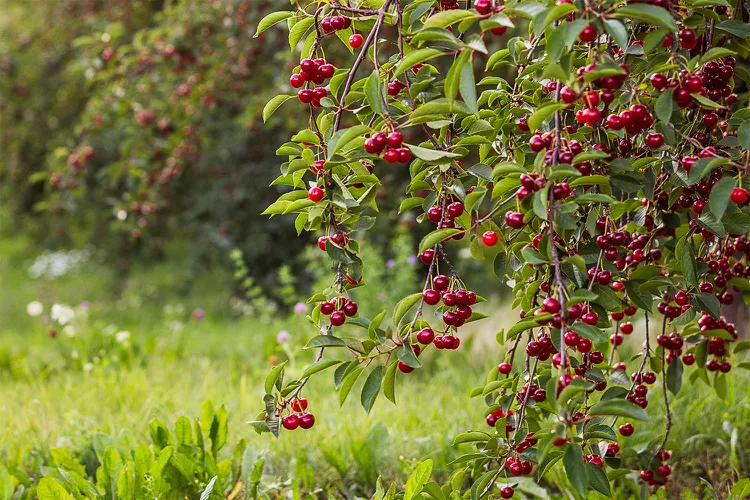
Often called dwarf cherries for their smaller size, sour cherries will reach about 20 feet if allowed to grow unchecked on standard root stocks. These trees grow best in USDA Zones 4-6; they favor cooler climates and are also more disease and pest resistant than sweet cherries. Sour cherries are typically used in baking rather than eating fresh due to their tart flavor. Self-fertile cultivars like ‘Montmoren’ produce copious amounts of bright red fruit.

2. Sweet Cherries

Unlike sour cherries, sweet cherries can be harvested and eaten directly from the tree owing to their exceptionally sweet flavor. Standard sized (non-dwarf) sweet cherries will grow to about 35-40 feet with age and do best in Zones 5-8. At maturity, popular cultivars like ‘Bing’ can produce nearly 100 pounds of deep red fruit in a single year.

Why Prune Cherry Trees?

While you don't have to prune cherry trees, doing so has a number of benefits for your fruit harvest. As mentioned, cherry trees can reach great heights and an annual pruning benefits the grower by slowing the upward expansion of the tree, making them much easier to harvest. Another benefit is that regular pruning opens up the canopy of trees to allow greater air flow and light penetration. The more light, air flow, and access to pollinators, the more fruit can be produced.

When to Prune Cherry Trees

The best time to prune fruiting cherry trees is in late winter before leaves have begun to emerge for the season. While dormant, the full form and structure of the tree is visible and any broken or crossed branches can easily be identified. In some regions, sweet cherry trees can be more susceptible to bacterial and fungal diseases. Because of this, some growers might prefer to prune their sweet cherry trees in late summer after fruit has fully set.

Cherry Tree Pruning Tools and Materials

Before you begin pruning your trees, always be sure to sterilize your tools with a solution of one part bleach mixed into nine parts water. The bleach will kill any potential bacteria, fungi, or viruses waiting dormant on your tools to invade plants through wounds.

To prune cherries, you will need a pair of pruning shears, hand saw, and for taller trees, a pole saw. A pair of gloves, long sleeved shirt, pants, closed-toed shoes, and safety glasses are highly recommended when doing any pruning. 

Tips for Pruning Cherry Trees

To begin pruning, first look for any broken or damaged limbs. Crossed branches will often rub together and produce seeping wounds, opening up the tree to infection. Dead branches will appear duller or lighter in color and should always be removed. Secondly, take a look at the base of the tree. Prune off any suckers or watersprouts coming from the base or along the stem. Branches below the graft union will not grow true to type and should never be allowed to grow.

Sour cherry trees should be grown in a large, vase-like shape. Newly planted and young trees should be “topped” by cutting the central leading stem. Rather, three to four lateral branches should be allowed to grow to provide the framework for the bulk of the tree. Ideally, these main lateral branches should be about 18-24 inches above the ground and evenly spaced to avoid future crowding.

Encourage further lateral branching by trimming off vertical, hanging, and thin branches. Prune off any branches growing toward the center of the canopy. Only remove about a third of previous year’s growth to encourage new growth. Sour cherries produce most of their fruit on the current year’s growth.

Unlike sour cherries, sweet cherries require less pruning than sour cherries and should be pruned along a central leader. As with sour cherries, remove any broken or crossed branches, vertical shoots that might compete with the central stem, and crowded growth. Encourage lateral branch development by pruning back by about a third. This will help in the development of new fruit buds.
Related Article

How to Grow Persimmon Trees from Seed

How to Grow Persimmon Trees from Seed

Use these easy step-by-step instructions to grow a persimmon tree from a seed.
10 Best Blueberry Companion Plants That Thrive in Acidic Soil

10 Best Blueberry Companion Plants That Thrive in Acidic Soil

Use these blueberry companion plants to boost your berry harvest and naturally control blueberry pests.
How and When to Harvest Radishes at Their Peak

How and When to Harvest Radishes at Their Peak

These easy-to-follow tips will help you figure out how and when to harvest radishes for the best flavor and size. Plus, get troubleshooting advice if your radish roots aren't developing properly.
10 Best Vegetables for Raised Beds and Small Spaces

10 Best Vegetables for Raised Beds and Small Spaces

These easy-to-grow crops are the perfect vegetables for raised beds because they love loose, well-draining soil.
10 Best Broccoli Companion Plants

10 Best Broccoli Companion Plants

Using broccoli companion plants, including some vegetables, herbs, and flowers, can help repel pests and improve the quality of your harvest.
4 Expert Tips for When and How to Cut Tulips in Your Garden

4 Expert Tips for When and How to Cut Tulips in Your Garden

Find out when and how to cut tulips and the best way to care for them so they last as long as possible.
Best Tropical Flowers for Your Patio

Best Tropical Flowers for Your Patio

Outdoor tropical flowering plants can help add drama to your patio. You can leave them outdoors and treat them like annuals, or keep them over winter as houseplants.
6 Long-Blooming Perennials That Keep the Color Alive

6 Long-Blooming Perennials That Keep the Color Alive

Say hello to some of our favorite perennials—three for sun and three for shade—that flaunt their color for weeks (or even months).
Is Coleus a Perennial or Annual? Here's How to Grow It Both Ways

Is Coleus a Perennial or Annual? Here's How to Grow It Both Ways

Is coleus a perennial that comes back every year? That depends on where you live and how you care for it. Use these tips to enjoy coleus as a colorful perennial or annual plant.
How to Plant and Grow Oxalis

How to Plant and Grow Oxalis

Oxalis is a diverse genus comprising hundreds of species, including annuals, perennials, and tropical plants.
Are Zinnias Perennials or Annuals? And How to Grow Them

Are Zinnias Perennials or Annuals? And How to Grow Them

You may be hoping this favorite garden flower will come back next year. But are zinnias perennials? Find out how to enjoy these plants from year to year.
How to Plant and Grow Agapanthus

How to Plant and Grow Agapanthus

Agapanthus is a low-maintenance perennial and landscape staple that produces clusters of trumpet-shaped flowers.
Light Up a Shady Spot with This Easy-Care Summer Shade Garden Plan

Light Up a Shady Spot with This Easy-Care Summer Shade Garden Plan

Enjoy this easy-care, summer-blooming shade garden plan that combines hydrangeas, roses, lilacs, and more.
This Bold Shade Garden Plan Brims with Color and Texture

This Bold Shade Garden Plan Brims with Color and Texture

This bold shade garden plan contains gorgeous foliage and flowers that don't need a lot of sun.
This Drought-Tolerant Garden Plan Saves Water and Time

This Drought-Tolerant Garden Plan Saves Water and Time

This drought-tolerant garden plan won't require as much watering as thirstier plants. Use this design to create a beautiful garden that will thrive even through dry spells.
An Island Flower Bed That Looks Gorgeous from Every Angle

An Island Flower Bed That Looks Gorgeous from Every Angle

Add excitement to your landscape with a bed of low-maintenance perennials around a flowering tree.
A French Kitchen Garden Plan Filled with Fresh Flavors and Scents

A French Kitchen Garden Plan Filled with Fresh Flavors and Scents

Our French kitchen garden plan filled with fresh flavors and scents is inspired by old-world monastery gardens.
The Top Deck Colors for Summer 2024, According to Experts

The Top Deck Colors for Summer 2024, According to Experts

Freshen up your outdoor space with these trending deck colors, from cool-toned paints to rich, warm stains.
12 Chicken Coop Ideas for Your Backyard Hens

12 Chicken Coop Ideas for Your Backyard Hens

These chicken coop ideas will help keep your flock safely contained while serving as an attractive addition to your landscape.
Everything You Need to Know About Landscape Edging

Everything You Need to Know About Landscape Edging

Landscape edging supplies a crisp edge between different areas of your yard. Use this guide to select the best edging for your garden design.